A Letter to Kansas City
June 12, 2026
Danny Beckley, President & CEO, Kansas City Symphony
The greatest cities of America are served by great symphony orchestras. Great orchestras give us a place to come together as a community around art that connects us to ourselves and to one another, to join in a common heartbeat, to simply be human together.
In the 2000s, this community set out to build its orchestra into a great one. About 15 years ago, the Kauffman Center for the Performing Arts opened its doors at an overall cost of $413 million. It is a glorious space, an architectural and acoustic world masterpiece that fulfilled the dream of Muriel McBrien Kauffman, carried out by her daughter Julia Irene Dennie-Kauffman, along with leadership support of Shirley and Barnett Helzberg, and many other philanthropists. This venue will be the home of our classical music and certain popular and contemporary offerings now and forever.
Maximizing on the promise of such a hall, our organization hired a charismatic new artistic leader in Michael Stern, and grew robust endowments to support the orchestra. Performing in a world class hall along with these bold undertakings set Kansas City on a path from having a modest regional orchestra (think a minor league baseball team) into having one of America’s symphonic gems.
Today, under the artistic leadership of one of the leading global stars in orchestral music, Matthias Pintscher, the Kansas City Symphony stands among the very finest orchestras in America, and increasingly on the global stage as well. We are receiving invitations from the best concert halls in the world—in fact far more than we can accept. This summer, our orchestra will return to the Berlin Philharmonie, Hamburg’s Elbphilharmonie, and Amsterdam’s Concertgebouw, following sold-out performances in all three in 2024.
The musicians we attract reflect this standing. Our musicians come from all over America, and some from larger orchestras. Among them are artists who left the Metropolitan Opera, the Houston Symphony, and the National Symphony, choosing Kansas City Symphony instead.
Your orchestra is becoming one of the most important voices in American classical music, and we belong to you and everyone in Kansas City.
I was brought here in 2019 to build up this orchestra. Specifically, I was charged by the board to develop sustainable and diversified funding mechanisms.
Answering this call, we have greatly expanded our programming, the places we perform, and the people whom we serve. We do this through a wide variety of orchestral offerings, and also by empowering (and paying) our musicians to develop and present programs on their own through innovations like the Mobile Music Box, and throughout the region in schools, churches, synagogues, hospices, hospitals, and community centers. Our music education programs reach tens of thousands of students each year, and we also provide orchestras to the Kansas City Lyric Opera and the Kansas City Ballet. According to data compiled by the League of American Orchestras, all of this makes us the most active orchestra in the country, and by a wide margin.
Yet for all of this performance activity, we face the same structural challenge of most orchestras today. In my time leading orchestras, bankruptcies and closures have become familiar headlines—Honolulu, Syracuse, New Mexico, and others either vanished or were forced to rebuild from the ashes. Even the mighty Philadelphia Orchestra declared Chapter 11, restructuring at the expense of its musicians and audiences. Here at home, the Kansas City Symphony is the third incarnation of a professional symphony orchestra for this region. The Kansas City Symphony Orchestra disbanded when its musicians went off to fight in WWI, and the Kansas City Philharmonic became insolvent in 1982.
It has always been expensive to run a symphony orchestra. It takes just as many musicians to play a Mahler symphony as it did 125 years ago. As a result, many orchestras run large structural deficits, where expenses outpace sustainable revenue, and we are no exception. Because the majority of an orchestra’s budget rightly goes to what you see and hear on stage, any major expense reduction would land directly on the concerts themselves. The opportunity must be on the revenue side.
Kansas City’s third endeavor to have a great orchestra has been the most successful by far. In just four decades, the Kansas City Symphony grew from a local startup to one of the top 20 American orchestras, a trajectory that our peers had a century to achieve. Kansas City will forever be indebted to the courageous founders of this orchestra: R. Crosby Kemper, Jr., Henry Bloch, Don Hall Sr., and others.
However, while more successful than the orchestras which preceded the Kansas City Symphony, sustaining today’s orchestra is no less challenging than those that came before. The Kansas City Symphony faces a choice: develop a major new stream of funding or shrink back to being a regional orchestra. That is no choice at all. We must act boldly to fuel the remarkable ascent the orchestra has made in service to Kansas City.
Our Solution
Our solution to the revenue need is to follow a proven model that many of our peers have taken. As orchestras are usually the foremost presenters of concerts in their markets, it often makes sense to expand their function into other genres beyond orchestral music. The Los Angeles Philharmonic runs the Hollywood Bowl, Boston Symphony has Tanglewood, Cleveland Orchestra owns Blossom, and there are many others. The most successful in this space is the Cincinnati Symphony, which took their presenting success in one venue and multiplied it to eight venues, plus artist booking relationships with several more.
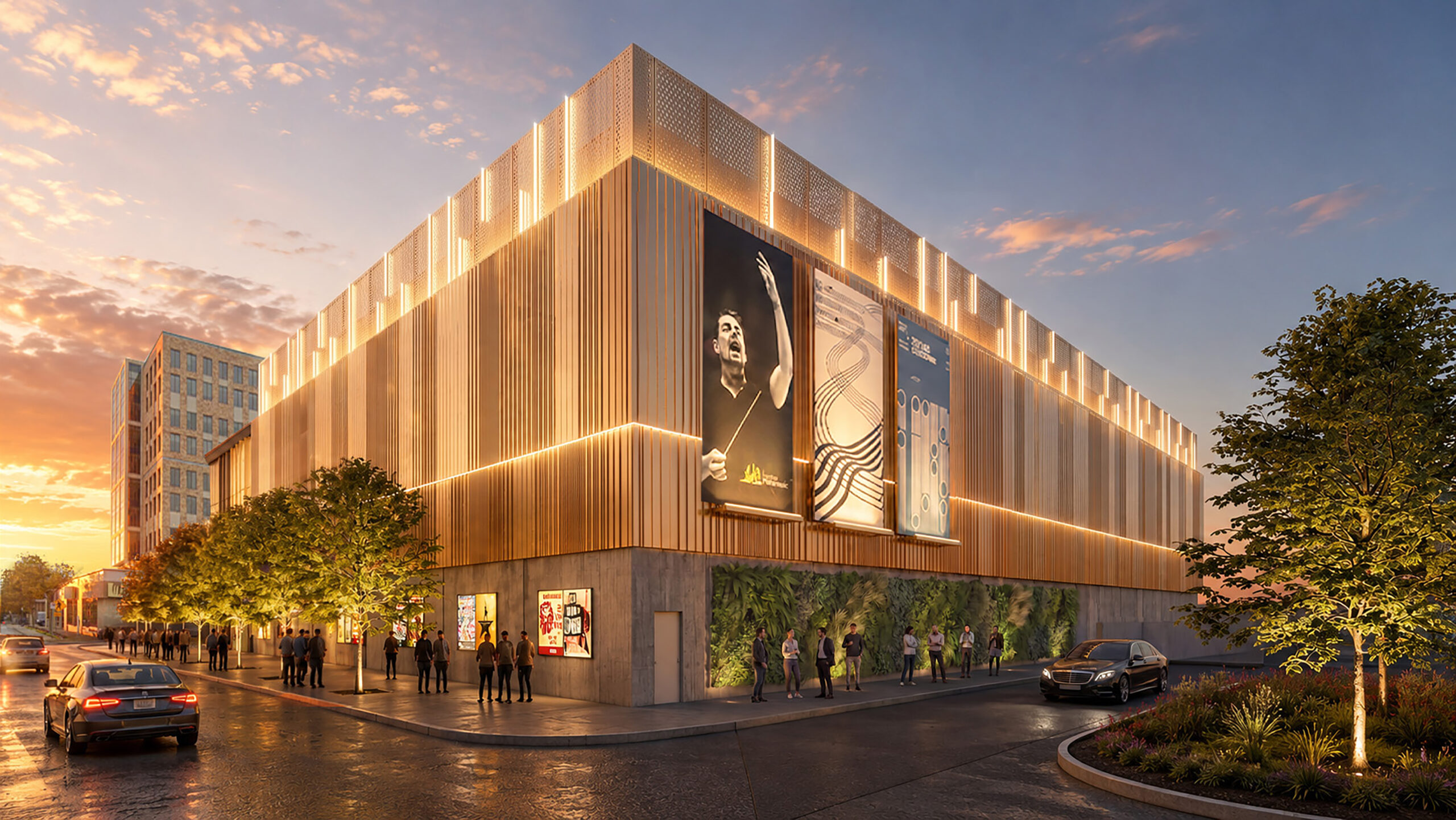
We are partnering with the Cincinnati Symphony’s venue and presentation arm, Music and Events Management, Inc. (MEMI), to help us create a new music venue in Kansas City. Ours is to be a modern indoor live music venue, best in class for amplified offerings, and catering specifically to every contemporary music genre except classical. The space is maximally flexible (the floor is flat and does not have permanent seating), enabling a wide range of concert experiences, ranging from a fully seated movie on a big screen to a rock show where the fans are on their feet. We could create the atmosphere of a jazz club at scale, or we could completely immerse the audience in sounds and effects to create an other-worldly experience. The key is flexibility, a blank canvas on which artists create and deliver the kinds of shows they imagine.
These kinds of flexible, mid-sized music venues are in high demand with both artists and audiences, with billions of dollars being spent around the world to create them. Contrasted against multi-purpose facilities like cordoned off sports arenas, these purpose-built music venues allow artists and audiences to be incredibly close to each other, to enjoy world class sound in a space designed for them. While our venue has an estimated peak capacity of 4,640 people, every person in the audience will be within 145 feet of the stage. (Leave your binoculars at home.) Food and drink is sold during the performance in the hall (there is no lobby) and restrooms are aplenty. It’s just you and the music, and everything you need to enjoy it.
Cincinnati Symphony’s MEMI built one of these spaces a few years ago, and it has been a hugely successful addition to their venue portfolio. Ours is a new and improved version of that one, and having the benefit of their learnings, we have more club space and premium seating opportunities. Additionally, ours is uniquely configured to host our symphony orchestra, specifically designed for our wildly popular Film + Live Orchestra concerts, where the orchestra plays the musical soundtrack in real time with the dialogue and action.
Working with MEMI gives us instant access to the touring artists already routed through their venues, as well as their four decades of experience running venues and promoting concerts. MEMI has sold more than 100 million tickets — they know this business.
Because MEMI is also a non-profit, fully owned by a non-profit orchestra, they define part of their mission as helping other orchestras do exactly what has been so fruitful in Cincinnati, and so that is what they are going to do for us. MEMI is helping us create this venue, and they will operate and program it for us as well.
Cost and Securing the Future of KCS
There has been a lot of interest about the cost of this venue, and how it will coexist with other venues in town, most especially the Kauffman Center. By understanding our new venue’s purpose, hopefully I have dispelled any notion that the Symphony would ever leave the Kauffman Center. But just to drive home the point, let me also demonstrate the same through a comparison of cost.
I mentioned earlier that when the Kauffman Center was constructed in the 2000s, the overall project cost was reported at $413 million. With inflation to materials and labor, a project on the scale and grandeur of the Kauffman Center today would easily exceed $800 million. In contrast, our project is capped at $70 million.
This is to say that our new venue is a different animal with a different purpose, and suggesting that the Kansas City Symphony would ever leave the Kauffman Center misunderstands both. The Kauffman Center is the Kansas City Symphony’s home, and Helzberg Hall is absolutely core to our artistic identity, to our very sound as an orchestra. The Symphony will continue to do over 100 performances each year at the Kauffman Center.
Funding
I have also heard a lot of interest in how we are paying for this. The Kansas City Symphony will be the sole owner of this venue, and our funding for this will come primarily from private philanthropy. Thousands of people faithfully donate to the Kansas City Symphony every year, and this is not an outsized project relative to the support we receive, nor to other projects in the market. Donors have quickly committed a large portion of our project need, and we will be working with hundreds of others to raise the balance over the next 30 months.
What This Means for Kansas City
In addition to securing the future of your orchestra, this venue gives Kansas City a remarkable new amenity. It is unlike anything in the market, the second indoor music venue built here in nearly a century. As a city so foundational to American music, Kansas City deserves it and should demand it.
The location we chose at 49th and Main is a boon to the city as well, enlivening one of the region’s most important districts. The venue will be a much-needed anchor for the shops and restaurants in and around the Country Club Plaza, drawing more than 300,000 people to the area year-round. The Symphony is committed to having the right people, partners, and policies in place to be good neighbors. We have secured abundant parking with nearby garage owners, so that we provide parking included in the price of a concert ticket, and we are confident that the complete concert experience will be outstanding for audiences and neighbors alike.
Timeline and Next Steps
We plan to open in September 2028. Given our fundraising momentum and the design-build progress with our construction partners, we are on track to do so, and you will see construction on the site by this fall.
This project will secure the future of the orchestra. The Kansas City Symphony is solving a structural problem boldly and proactively, while being smart about risk: a proven model, a proven kind of venue, and proven partners in MEMI, Populous, and McCownGordon. The greater risk is in not doing it. We must move forward, or we risk losing what has been built over four decades. Now is the time for the next evolution of the Kansas City Symphony.
This is Kansas City’s time. Because this new venue is owned locally, by a cultural institution that exists for public benefit, this project does more than add to one of the most important music cities in America. It directly strengthens the region’s largest performing arts organization.
Please join us in this new chapter for Kansas City and your orchestra. If you would like to learn more, I would be glad to hear from you at danny.beckley@kcsymphony.org.
Additional Kansas City Symphony Facts
- Top 20 Orchestra: Of over 2,200 orchestras in America, Kansas City Symphony is in the top 1%
- 340 performances given last season, the most of any American orchestra
- $25 million KCS annual operating budget, the most cost-efficient of our peers
- 80 full-time musicians have moved to Kansas City for this job
- 162 musicians from around the country typically apply for one open position in our orchestra
- KCS is the largest performing arts organization – and largest employer of performing artists – in hundreds of miles
For more questions about the new music venue, visit our info hub.
Related Posts
03/30/26